|
A wildlife tour in India would take you to the Sunderbans, which is the most popular tiger habitat in India. 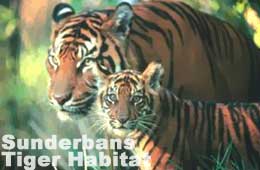 These forests are spread in an area of 1,000,000 hectares, is the world's largest delta, formed by the Ganges, Brahmaputra and Meghana rivers. The vast swampy delta extends over areas comprising of mangrove forests, swamps and Forest Island, all interwoven in a network of small rivers and streams. The Sundarban National Park, home of the Royal Bengal Tiger and the largest mangrove forest in the world, form the core of this area. These forests are spread in an area of 1,000,000 hectares, is the world's largest delta, formed by the Ganges, Brahmaputra and Meghana rivers. The vast swampy delta extends over areas comprising of mangrove forests, swamps and Forest Island, all interwoven in a network of small rivers and streams. The Sundarban National Park, home of the Royal Bengal Tiger and the largest mangrove forest in the world, form the core of this area.
The islands of Goasaba, Sandeshkali and Basanti form the northern boundary of the Sundarbans. On the south is the sea; to the west side of the Sunderbans Park is the Matla and Bidya rivers and to the east is the international boundary of Bangladesh. The holy Ganga journeys down the Himalayas and flows along India's vast monotonous plains into the state of West Bengal. Towards the southern tip of the state, the land and the Bay of Bengal break out into a lively welcoming fandango to form a fresco of tangled mangrove swamps - the Sunderbans.
In order to preserve the broad mangrove types found here, the area between River Hooghly and the River Teulia was declared a National Park in the year 1984. The protected reserve covers a stretch of 1,330sq km, and also constitutes the core zone of the National Park. The tiger habitat of Sunderban is distinctly different from any other reserve. Yet the tiger has retained its basic characteristic and flourished in this expanse of deltaic estuary.
On your wildlife tour to India you can visit the Sunderbans, known for its Tiger Habitat, which is vastly distinct from any other tiger reserve. Out of 2585 square kilometers of the reserve, 900 square kilometers is covered by water. Total land area plus a part of the water area, comprise the tiger territory. The landmass is divided into a large number of islands by channels and creeks.
The floor under vegetative cover is laid with stout spiky pnumatophores on which tigers have to tread. They have to drink saline water, unlike in other tiger territories. Yet the tiger has retained its basic characteristics. It's tracking of the prey, staking and mode of attack has no distinction from its counterparts in other areas. Compared to other reserves in the world, this park has the largest population of tigers, and also abounds in salt water crocodiles, olive Ridley turtles, Gangetic dolphins, chitals, fishing cats, wild boars, otters, rhesus macaques, monitor lizards, snakes, innumerable fishes, crabs, lobsters, shrimps, worms and a host of birds including kingfishers, storks, herons, Brahmin ducks, arghilahs, ibises, water fowl and egrets, to name only a few.
These forests are the livelihood of around 5,000 fishermen who are dependant on mangroves fishery in salt waters within the reserve. Fishing is allowed only in the buffer zone to the people having valid permits. Each fishing party consists of four fishermen in a boat. Permits are issued for periods ranging from two to eight weeks. Narrow watercourses are ideal fishing areas. Very narrow channels easily coverable by nets are ideal spots.
Like fishing, honey collection is allowed in the buffer zone only during the months of April and May. The honey collectors, before the start of their actual operation, fine tune their reflexes to respond promptly to the dangers of a lurking tiger while combing the forest for honeycombs. The honey container, the hay bundles to smoke out the honeybees and the equipment to collect honeycomb are their only defence weapons. Their knowledge about the behavior of the tiger is almost instinctive, and developed through long years of actual exposure.
The cardinal object to Project Tiger is based on the idea of total conservation with the tiger conservation with the tiger at the apex of the ecosystem. But since the time of the first settlement of population in the reclaimed islands adjoining the forests, wood collection has been a major means of livelihood for the people. Stray woodcutting is not allowed in the reserve. Since the advent of Project Tiger in this Reserve, patrolling specially protects the area.
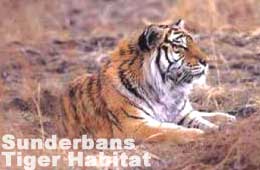 It is a difficult job for the project authorities to control encroachment of the tiger habitat. Therefore there is always confrontation between man and tiger. Of late, there has been an improvement because of the intensive publicity programmes adopted by the Project authorities.
Fact File:
Getting There: Kolkata is the nearest airport is at a distance of 112-kms from the Sundarbans National Park. The nearest railhead is Canning, 48-kms away from the Sunderbans National Park. From Port Canning, regular buses ply to Sonakhali, Raidighi, Najat and Namkhana.The excellent road network connects Namkhana to Kolkata, Sonakhali (100-kms), Raidighi (76-kms), Canning (64-kms), and Najat (92-kms), all lying nearby the Sunderbans.The tourists can hire a cruise in the riverine waterways from different places covering different stretches like Namkhana - Bhagabatpur Crocodile Project- Sagar Island -Jambudweep; from Sajnekhali - Sudhanyakhali-Buridabri- Netidhopan-Holiday Island; from Sonakhali - Gosaba; from Raidighi - Kalas. The watchtowers at Netidhopan, Sajnekhali, Sudhanyakhali and Haldi- provide you an excellent view of the wildlife.
Accommodation: Accommodation is at Sajnekhali Tourist Lodge and new resorts at Gosaba and Bali Islands. We recently stayed at the Bali Jungle Camp, which was well appointed and comfortable.
Climate: The best time to visit the Sundarbans National Park is during the months of September and May. The possibility of observing the mighty Royal Bengal Tiger enhances in the winter season when one can watch the King of Jungle sun-bathing on the banks of the river. For this reason the ideal time to visit the sanctuary is December and January.
| 
